Stop the “Tomorrow” Habit, Simple Planning That Helps You Start Today
Last Sunday night, you told yourself you’d start on Monday. You even opened a notes app, typed a few goals, then closed it because you were tired. Monday showed up, work ran long, dinner happened, and you went to bed thinking, “Tomorrow.” A week later, you’re saying the same thing, and somehow your plan has become a permission slip to wait.
That’s the quiet problem with planning when it’s built around “later.” If your to-do list lives in the future, delay starts to feel normal, then it turns into a habit. You’re not lazy, your plan just keeps pushing the first step out of reach.
This post will show a simple, kind way to plan so today counts. You’ll learn how to make your next action small enough to start, how to set deadlines that don’t scare you off, and how to keep momentum even on messy days. Progress doesn’t need a perfect Monday, it needs a clear first step you can take right now.
If you want a quick mindset boost alongside this, this TED-Ed video is a solid watch: https://www.youtube.com/watch?v=FWTNMzK9vG4
How “I’ll do it tomorrow” turns into a habit (and why it feels so normal)
The “tomorrow” habit usually starts as a sensible choice. You feel stressed or bored, you avoid the task, and you get a fast hit of relief. Then guilt shows up later, so you promise you’ll do it tomorrow to feel better. After a few repeats, your brain begins to treat delay like the normal solution.
That’s because your brain likes comfort and quick rewards. Starting feels uncertain, but avoiding feels safe. The good news is this loop is common, and it’s changeable once you can spot what’s really happening.
The hidden reward of procrastination: quick relief
When you put something off, you don’t just “do nothing.” You trade a hard feeling for an easier one. Stress drops. Boredom disappears. For a moment, it can feel like a small win.

Think about laundry. You see the basket, you remember the steps (sort, wash, dry, fold), and you feel that mild dread. So you sit down “for a minute.” Your body relaxes because the pressure is gone. Your brain quietly logs a lesson: avoidance works.
That relief is the hidden reward. It trains you the same way a snack trains a craving. Next time you feel that same stress, your brain suggests the same fix: push it to tomorrow.
Procrastination often isn’t laziness, it’s relief-seeking. You’re trying to feel better fast.
Later, the bill comes due. The basket grows, the email thread gets longer, or the workout feels even harder to start. Then guilt shows up, and guilt is uncomfortable, so you reach for the quickest comfort again: “I’ll start tomorrow.”
Planning that is too big makes tomorrow feel safer than today
Big, vague plans sound motivating, but they usually create pressure. “Get my life together” isn’t a plan, it’s a fog. Because you can’t see the first step, your brain treats the whole thing like a threat.
Meanwhile, tomorrow feels safer because it’s imaginary. Tomorrow has more time, more energy, and a better version of you. Today has dishes, distractions, and a real clock.
Here’s the contrast that changes everything:
- Too big: “Start working out again.”
- Clear and small: “Put on shoes and walk for 8 minutes.”
- Too vague: “Handle my email.”
- Clear and small: “Reply to the oldest message only.”
Small plans lower the “starting cost.” They also shrink the stress that triggers avoidance in the first place. Once you begin, momentum often shows up on its own.
Decision fatigue: too many choices, so you choose later
Decision fatigue is what happens when your brain gets tired of choosing. Every choice uses energy, even small ones. After a long day, your brain wants the easiest option, and “later” is one of the easiest options available.
That’s why end-of-day scrolling feels so tempting. It’s not asking you to decide anything. In contrast, a messy to-do list demands constant judgment: What first? What matters? How long will it take? If nothing stands out, your brain stalls.

A few quick signs you might be dealing with decision fatigue:
- You “research” instead of starting, like reading tips on studying but not opening the book.
- You bounce between tasks because nothing feels like the right choice.
- Simple things feel weirdly hard, like picking one email to answer or choosing a workout.
When decisions pile up, procrastination becomes your default because it reduces mental load fast. The fix starts with fewer choices and one clear next step.
Plan in a way that makes starting easier than skipping
If your plan makes you feel behind before you begin, your brain will look for an exit. The goal is a plan that lowers friction, not one that proves you have “discipline.” When starting feels simple, skipping starts to feel unnecessary.
Think of planning like setting out a welcome mat. You want your future self to walk in without a debate. That means choosing smaller actions, looser time blocks, and quick starts that build momentum fast.
Use the “next right step” rule instead of a giant to-do list
A giant to-do list often mixes projects and actions, then calls them all “tasks.” That’s a trap, because projects don’t start. Actions start.
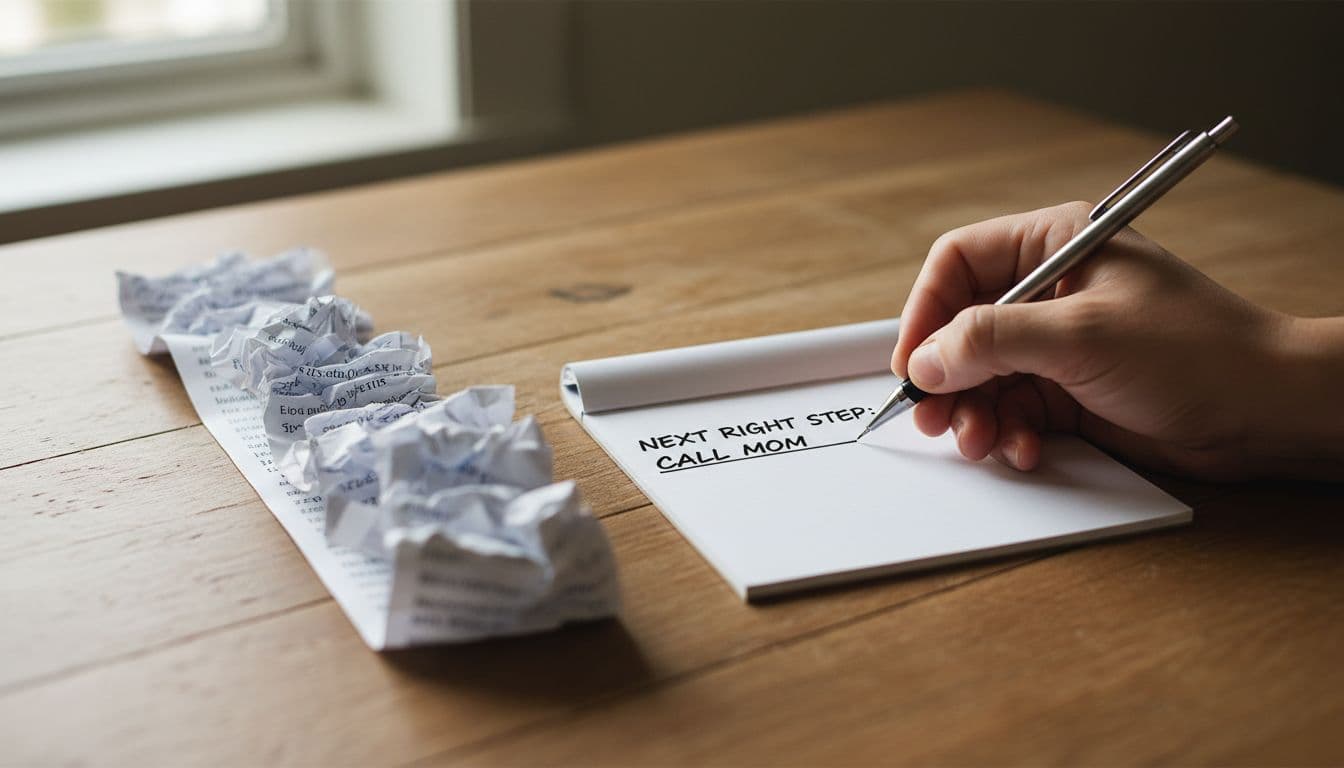
Here’s the difference:
- Project: something that takes multiple steps (often vague).
- Next action: one physical, obvious move you can do in one sitting.
For example, “write report” is a project. It hides a dozen steps, so your brain hesitates. A next action sounds more like: “Open the doc and write the first 3 bullet points.” Now you can begin, because you know what “done” looks like.
Try this quick rewrite template you can copy:
- Project:
____________________ - Next right step (10 minutes or less):
____________________
A few more examples:
- “Study for biology” becomes “Open notes and review headings for Chapter 4.”
- “Clean the kitchen” becomes “Clear the counter and start one load of dishes.”
- “Apply for jobs” becomes “Open one posting and paste it into a notes file.”
Most importantly, pick one next step per priority. If you choose three, you’ll negotiate. If you choose one, you’ll start.
If you can’t do it without thinking, it’s still a project. Make it smaller until it’s obvious.
Time-blocking for real life: leave space for delays and mood
Time blocking is simple: you decide when you’ll do something, not just what you’ll do. Still, most people overdo it. They pack the day tight, then one delay breaks the whole plan.
A “real life” version uses 2 to 3 blocks a day, plus buffer time. That’s enough structure to start, without turning your calendar into a guilt machine.
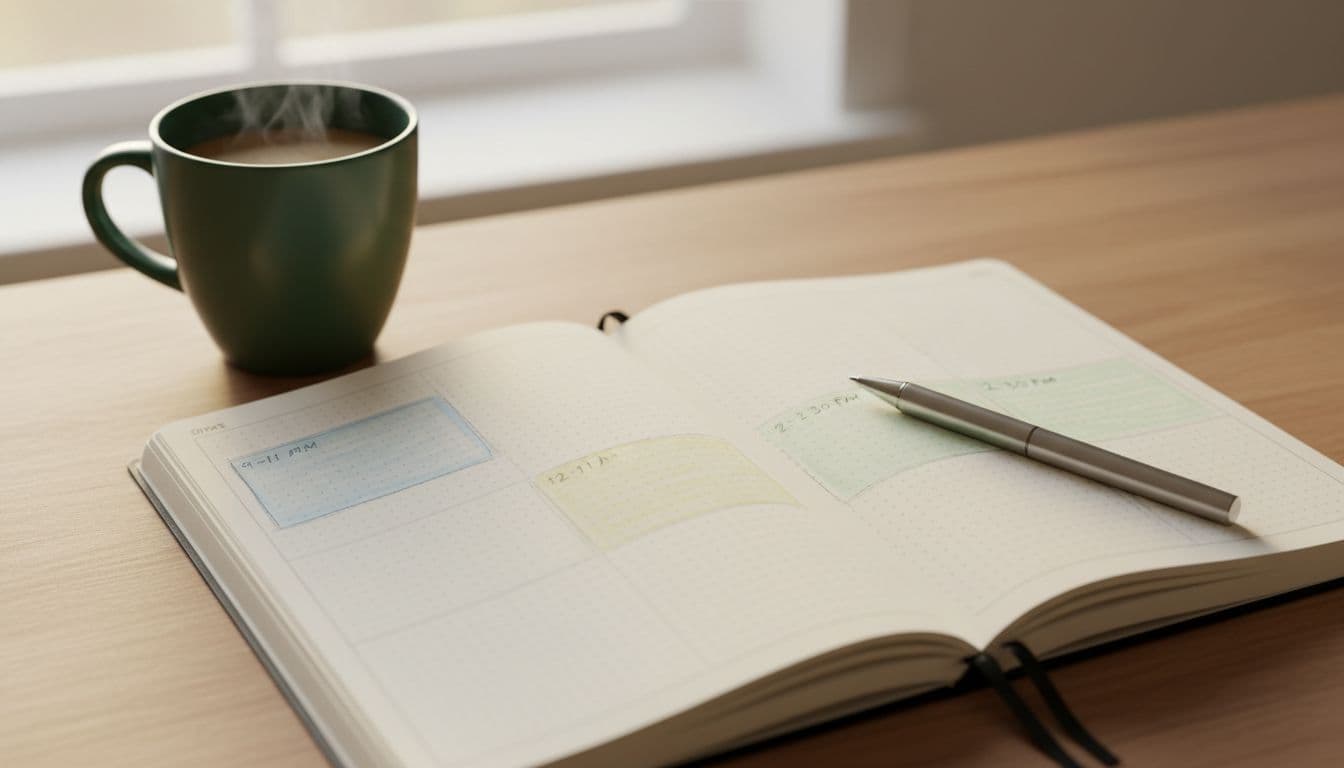
Here’s a copyable template:
- Block 1 (priority):
____ to ____ - Buffer:
____ to ____ - Block 2 (admin or chores):
____ to ____ - Block 3 (optional / bonus):
____ to ____
Example day (working adult):
- 8:30 to 9:30: Deep work (one “next right step” only)
- 9:30 to 10:00: Buffer (emails, delays, reset)
- 12:30 to 1:00: Admin (two messages, one form, one call)
- 6:30 to 7:00: Life block (quick workout or meal prep)
Example day (student):
- 10:00 to 11:00: Class review (summarize one lecture)
- 11:00 to 11:30: Buffer (snack, walk, catch up)
- 2:00 to 3:00: Assignment block (outline only)
- 7:00 to 7:30: Prep for tomorrow (bag, notes, quick reset)
Treat blocks as invitations, not punishments. If you miss one, you don’t “fail.” You move it or shrink it, then start anyway.
Make it stupid-easy to begin with a 10-minute launch
Motivation is unreliable. Momentum is easier to earn. That’s why a 10-minute launch works so well, it gets you moving before your brain can argue.
The rule: set a timer for 10 minutes. During that time, you only do setup plus the first tiny action.
A simple 10-minute launch (copy this):
- Set timer for
10:00. - Set up (open laptop, clear space, get materials).
- Do one tiny action (first bullet point, first paragraph, first problem).
- When the timer ends, choose: stop guilt-free, or keep going.
Pair it with a cue so it becomes automatic:
- After coffee
- After shower
- After you sit at your desk
- After you get home and change clothes
Starting becomes a reflex when it’s tied to something that already happens. Over time, that small start does more than any “perfect plan.”
Write a “done list” to train your brain to notice progress
A plan feels rewarding when you can see proof you’re moving. That’s what a done list gives you. Instead of only tracking what’s left, you track what you finished, even if it’s small.

Keep it simple: 3 small wins daily. You can write them on paper, in Notes, or in a habit app. The format matters less than the practice.
Copyable done list template:
- Win #1:
____________________ - Win #2:
____________________ - Win #3:
____________________
Wins can be tiny and still count:
- “Opened the doc and wrote 3 bullets.”
- “Sent the email I avoided.”
- “Walked for 8 minutes.”
- “Put laundry in the washer.”
Progress beats perfection because it builds trust with yourself. Once your brain expects a win, planning stops feeling like pressure and starts feeling like payoff.
An evening plan that stops tomorrow from stealing your week
A good evening plan is like setting the coffee maker before bed. You do a few small steps while you still have control, so morning-you doesn’t have to negotiate. The goal is simple: close open loops, pick a few priorities, and make the first step hard to miss.
Keep it calm. This is not a strict routine or a new personality. It’s a short reset that takes about 10 to 15 minutes and protects your week from the “I’ll do it tomorrow” habit.
Do a quick reset: clear your head before you plan
Planning works better when your brain stops spinning. So first, get everything out of your head and onto paper. Set a timer for 3 minutes and do a fast brain dump. Write messy. Write fragments. If it’s loud in your mind, it belongs on the page.

Next, take one minute to sort what you wrote into quick buckets. Keep it simple:
- Do tomorrow: real tasks that matter.
- Schedule later: things with a date (calls, appointments, bills).
- Someday: good ideas that are not for tomorrow.
This helps because your brain hates open loops. When it thinks you might forget, it keeps tapping you on the shoulder at night. A brain dump tells your mind, “It’s captured,” which lowers anxiety and can make falling asleep easier.
One practical rule prevents sticky-note chaos: keep your list in one place. Choose one notebook, one notes app, or one planner page. If you scatter reminders across receipts and scraps, you’ll feel busy but still unsure.
Pick tomorrow’s top three, and make them small enough to finish
After the reset, choose tomorrow’s top three. Not ten. Not “everything.” Three gives you focus without making the day feel locked down.
A good set usually includes:
- One must-do (work, school, money, health, or a deadline).
- One maintenance task (admin, cleaning, email, errands).
- One personal win (something that makes you feel like a person again).
Then shrink each task until it’s finishable. If a task feels heavy, it’s often a project in disguise. Turn it into a small action that can fit into a real day.
Use this quick mini-checklist for each top three item:
- First step: What is the first physical action? (Open the doc, pull out the pan, put shoes on.)
- Time estimate: How long will it take? (Be honest, then add a small buffer.)
- Done means: What exact result counts as finished? (Two paragraphs, one load washed, appointment booked.)
For example, “work on presentation” becomes “open slides and outline the first three bullets.” “Get back in shape” becomes “walk 10 minutes after lunch.” Small doesn’t mean silly. Small means you’ll actually start, and starting is the whole point.
If you can’t tell whether you finished it, you didn’t define it. Give “done” a clear edge.
Set up your environment so morning-you cannot miss the plan
This is the part most people skip, then they wonder why the plan disappears by 9:10 a.m. Environment design is planning, because it removes decisions when your willpower is low.
Think of it like setting pins up for a bowling ball. If the lane is ready, you just roll.
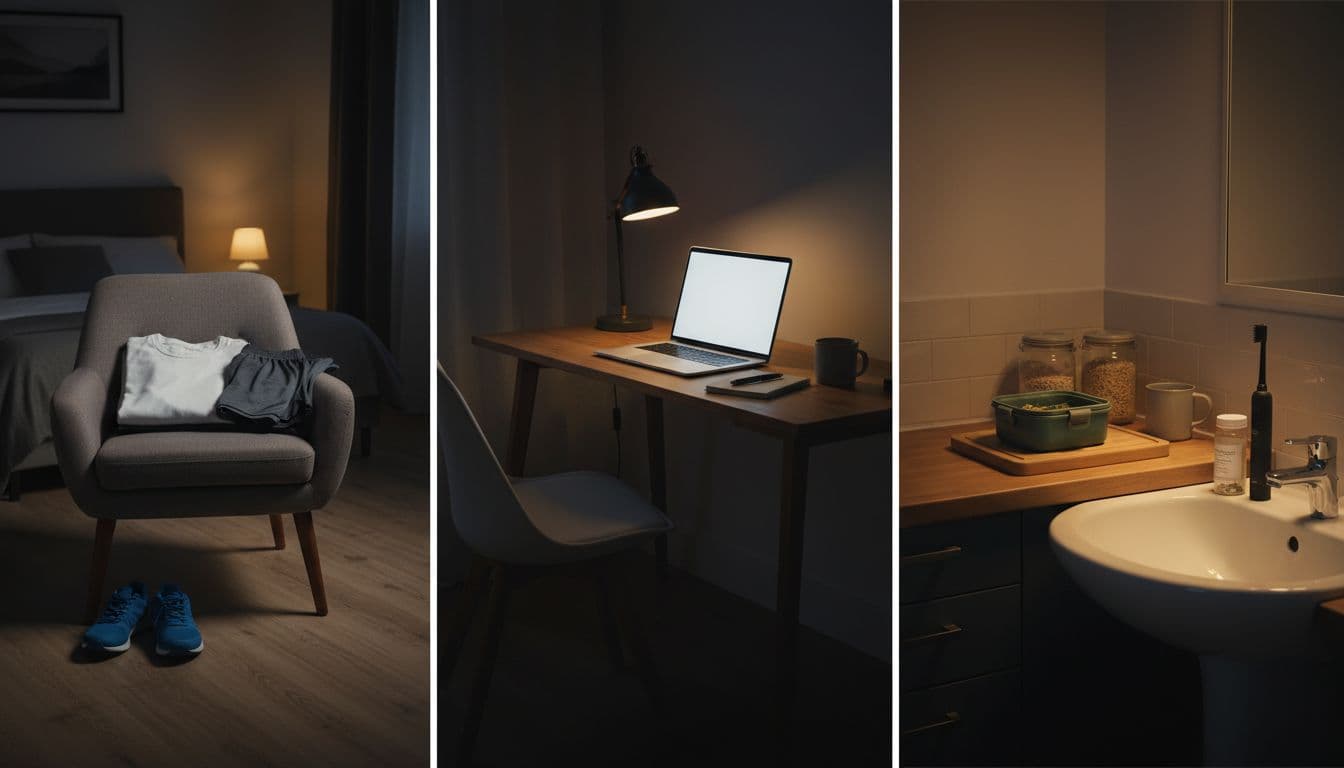
Use practical setups that match your top three:
- If you want to work out, lay out gym clothes and shoes where you’ll see them first.
- If you need to write or study, open your laptop to the exact document (or leave the tab ready).
- If you forget meds, place them by your toothbrush (not in a cabinet).
- If mornings get chaotic, pack lunch and put it where you can’t miss it.
- If your next action needs tools, set them on the counter (not buried in a drawer).
Also, make your plan visible. Put tomorrow’s top three on a single card, a single sticky note, or the first page you’ll open. The aim is not aesthetic. It’s to make the next step obvious before your phone steals your attention.
End with a shutdown phrase so your brain lets go
Finally, give your day a clear ending. Without closure, your mind keeps the tabs open, even when you’re lying in bed. A simple shutdown phrase draws a line between “working brain” and “resting brain.”
Say it out loud, the same way each night:
“Plan is set, I am done for today.”
This works because your brain responds to signals. A repeatable phrase becomes a cue that planning is complete. You captured what matters, you chose the priorities, and you set up the environment. As a result, you stop replaying tomorrow in your head.
If a worry pops up after that, don’t renegotiate your night. Just tell yourself, “It’s in the plan,” and return to rest. That’s how you keep tomorrow from creeping into your evening, and stealing your week one night at a time.
When life gets messy: how to keep planning without giving up
Some weeks don’t cooperate. You get low energy, a kid gets sick, work piles up, or a surprise bill shows up. In those moments, a rigid plan can backfire because it turns into one more way to feel behind.
The fix isn’t quitting planning. It’s switching to a simpler mode that keeps you moving while life is loud. Think of it like driving in the rain, you slow down, you keep both hands on the wheel, and you still head in the right direction.
Use a “minimum plan” on bad days
A minimum plan is the smallest version of planning that still protects momentum. It has three parts: one tiny task, one self-care step, and one reset. You’re not trying to win the day, you’re trying to stay connected to your goals.

Here’s what that can look like in real life:
- Work: Tiny task: reply to the oldest email. Self-care: drink water and eat something with protein. Reset: clear your desk for 2 minutes and write your next step on a sticky note.
- School: Tiny task: open the assignment and write the first two bullet points. Self-care: take a 10-minute walk. Reset: pack your bag and charge your laptop.
- Home: Tiny task: start one load of laundry. Self-care: shower or stretch for 5 minutes. Reset: do a fast counter sweep and set out tomorrow’s clothes.
Keep it honest. If you’re running on fumes, your minimum plan might be “send one message, take meds, put dishes in the sink.” That counts.
Consistency beats intensity. A small plan you repeat builds trust with yourself.
If you miss a day, do a restart, not a spiral
Missing a day is normal. The problem starts when you treat it like proof you “always mess up.” That’s all-or-nothing thinking, and it feeds the tomorrow habit because it makes starting feel pointless.
Use this simple restart script. Say it in your head or write it down:
- Notice: “I missed yesterday.”
- Forgive: “That happened. I’m not doing a guilt tour.”
- Choose one next step: “I’ll do 10 minutes on the first action.”
- Plan the next 24 hours only: “Today: one priority, one support task, one reset.”
Planning only the next day matters because it shrinks the mental load. A week-long comeback plan can feel heavy, so your brain waits for a “better” day. A 24-hour plan feels doable, therefore you actually start.
If family stress or surprise tasks hit, adjust the plan instead of tossing it. Swap in a minimum plan and keep the chain unbroken. Starting small is still starting.
Know the difference between procrastination and burnout
Sometimes you’re avoiding a task because it’s boring or uncomfortable. Other times, you’re not avoiding, you’re running out of fuel. Those two problems need different responses.
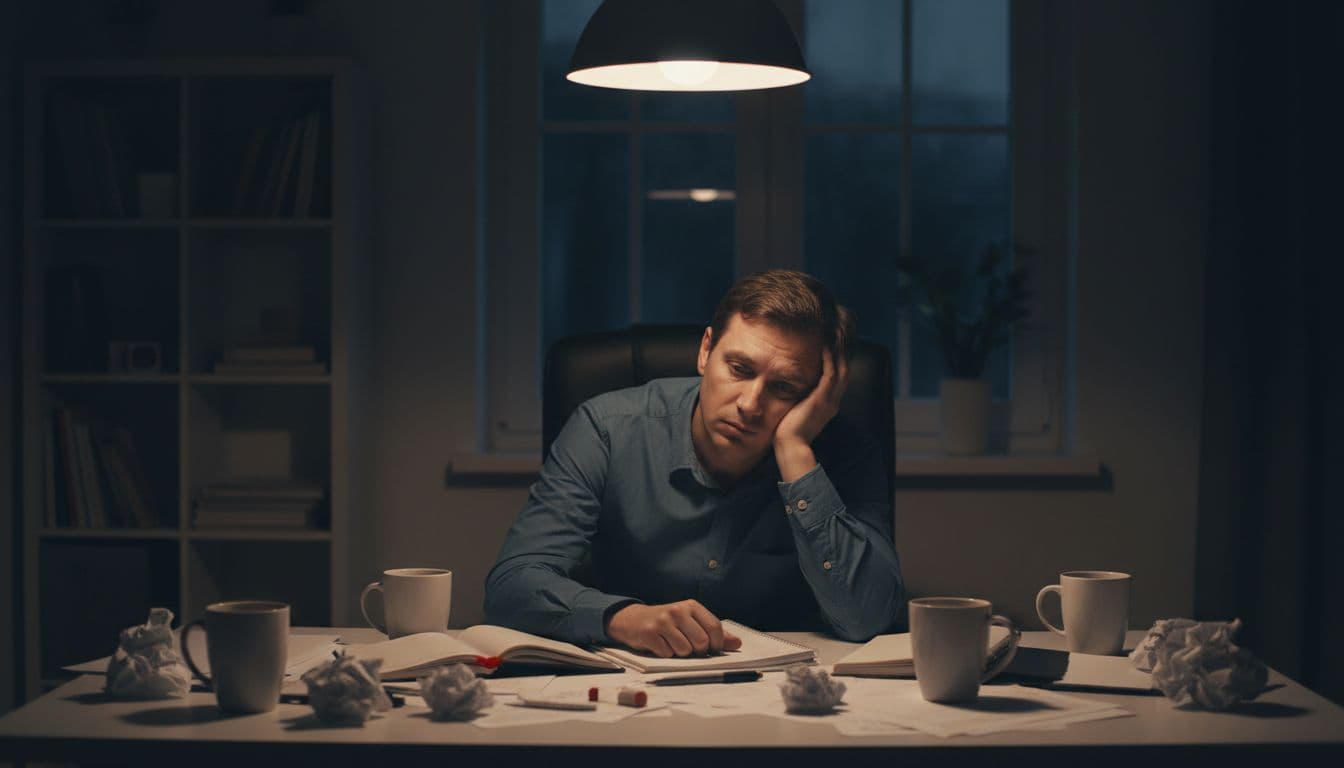
Burnout often shows up like this:
- Exhaustion: Rest doesn’t feel like it helps much.
- Cynicism: You feel detached, irritated, or numb about work or school.
- Lower performance: Simple tasks take longer, and mistakes increase.
Basic procrastination looks different. You may have energy for other things, but you avoid one specific task. You might tidy, scroll, or “research” instead.
Supportive actions for burnout are practical, not dramatic. Start with sleep, food, and time off if you can. Next, talk to your manager, teacher, or advisor about deadlines or workload. Ask for one change you can name, like a smaller scope, a revised due date, or fewer meetings for a week.
If procrastination feels severe or comes with constant anxiety, focus issues, or low mood, it can help to talk with a licensed therapist or a doctor. ADHD, anxiety, and depression can make starting much harder, and getting support can change everything.
Conclusion
Planning stops becoming a “tomorrow” habit when it stops trying to control your whole day. Instead, it works when it makes the next step clear, small, and easy to start, even when you feel tired or busy.
That’s why the tools in this post matter. The next right step turns big goals into actions you can finish. Time blocks with buffer give your day shape without turning it into a trap. The 10-minute launch gets you moving before your brain starts bargaining. Then the evening top three keeps tomorrow focused, and a minimum plan protects progress when life gets messy.
So keep planning simple, and keep it kind. When you can start, you build trust with yourself, and that’s what makes follow-through feel normal.
Tonight, take 10 minutes to plan. Pick one small task for tomorrow morning, write the first step so it’s obvious, then start for just 10 minutes.