One More Round: Break Any Goal Into Your Next Small Win (Bell Mindset Edition)
You know that moment when a goal feels so big you can’t even pick a starting point? You stare at your notes, your calendar, your to-do list, and everything feels heavy. So you do nothing, then you feel worse, then you promise you’ll “get serious” tomorrow.
One More Round is the simple fix for that stuck feeling. It turns any goal into the next small win you can do today, even when you’re tired, busy, or not in the mood.
This is the Bell Mindset Edition, which means you’ll use a repeatable loop: hear the bell (a cue), take one small action, log the win, then reset. No drama, no perfect plan, just a clean next step. By the end, you’ll have a step-by-step method, real examples, and a quick plan you can copy for any goal.
What “One More Round” really means (and why it works when motivation fades)
“One more round” is a way of thinking that trades a huge future change for a doable action right now. You’re not asking, “Can I finish the whole thing?” You’re asking, “Can I do one more round?”
A “round” is small on purpose. It’s a short burst you can start fast and finish clean. Most rounds take 2 to 15 minutes. That time limit matters because it lowers friction. When a task feels easy to begin, you begin it more often.
This also builds momentum. One small win makes the next win easier. You stop waiting for motivation and start creating it. Even better, repeated rounds shape identity. After a week of short writing rounds, you don’t just “try to write.” You start to see yourself as someone who writes.
Feedback is another reason it works. Big goals often give you no payoff for weeks. Small wins give you proof today. Your brain likes proof.
Here’s the contrast that changes everything:
- A giant goal says, “Become a new person.”
- A next small win step says, “Do the next right action.”
The first approach invites pressure. The second invites action.

The Bell Mindset loop: cue, action, score, reset
Cue (hear the bell): The bell is a trigger you already notice. It can be a real alarm, but it can also be a daily moment, like finishing coffee or opening your laptop. The point is to stop relying on memory.
Action (do the round): This is the smallest version that still counts. For example, after brushing your teeth (cue), do 5 minutes of stretching (action). Keep it simple enough that you don’t negotiate.
Score (log the win): Mark it in a way that feels satisfying. A checkmark counts. A tally mark counts. Scoring makes the win real, not vague.
Reset (start fresh): Reset is what keeps you from spiraling after a missed day. You don’t “ruin it.” You reset and listen for the next bell. That’s how you stay steady.
The Bell Mindset isn’t about never missing. It’s about returning fast, without punishment.
Small wins beat big plans, because they are easier to repeat
Big plans can feel safe because they live on paper. Small wins feel riskier because you have to do them. Still, small wins win because repetition beats intensity.
A single hard workout doesn’t change much. Ten short workouts change a lot. The same is true for studying, saving money, and building a business. Consistency stacks.
“One more round” also protects you from all-or-nothing thinking. If you can’t do the full plan today, you can still do a round. That keeps the habit alive, and it keeps your self-trust intact.
How to break any goal into your next small win step
Most goals fail for a simple reason: the next action isn’t clear. You have a dream, but you don’t have a round.
Use this process to turn any goal into a single next step that takes 2 to 15 minutes. Keep the output concrete, not “work on it.”
Here’s the method:
- Name the finish line in plain words. Make it measurable enough that you’ll know when you’re done.
- List the main parts (just 3 to 5). Think of these as buckets, not detailed tasks.
- Pick the part that feels most blocked. That’s often where your next round should live.
- Ask, “What can I do in the next 10 minutes?” Choose something that moves that part forward, even a little.
- Shrink it until it’s startable, then set a bell. If you’d avoid it, it’s too big. If it feels pointless, it’s too small.
That’s it. Your next round is not your whole plan. It’s the next small win step you can finish today.
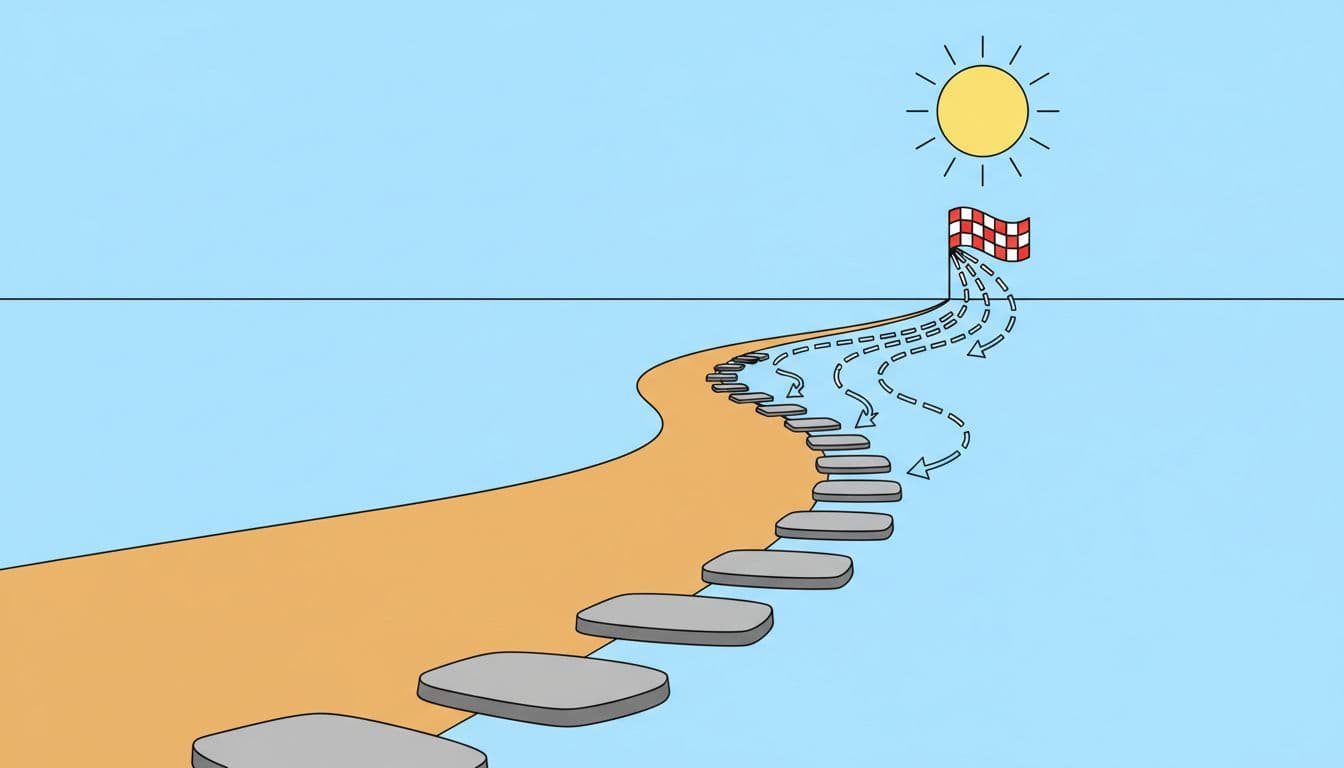
Start with the finish line, then work backward to the next 10 minutes
Vague goals create vague actions. So first, tighten the finish line.
Instead of “get fit,” try “walk 30 minutes, 4 days a week for 8 weeks.” Instead of “grow my business,” try “sign 3 new clients by June 30.”
Once the finish line is clear, work backward to the next 10 minutes. Not the next week. Not the perfect schedule. Just 10 minutes.
Examples:
- Fitness: Finish line is “walk 30 minutes.” Next 10 minutes could be putting on shoes and walking to the end of the street and back.
- Study: Finish line is “pass the exam.” Next 10 minutes could be opening notes and writing 5 question prompts from today’s topic.
- Business: Finish line is “3 new clients.” Next 10 minutes could be drafting one outreach message and sending it to one person.
- Relationships: Finish line is “feel more connected.” Next 10 minutes could be sending a thoughtful text that includes one real detail, not “hey.”
Notice the pattern. The round is small, but it points at the finish line.
Use the 2 to 15 minute rule to pick a round you will actually do
A round should feel almost easy to start. That doesn’t mean it’s comfortable. It means it’s low-friction.
Use this quick sizing test:
If you keep avoiding it, it’s too big right now. Shrink it. If it feels meaningless, it’s too small. Add a little weight.
Here are a few rounds that fit the rule:
Write 100 words, not a full blog post.
Walk 8 minutes, not an hour.
Open your budget app and label 3 expenses, not “fix my finances.”
Do 10 pushups, not “start a workout plan.”
Practice a guitar chord change for 7 minutes, not “learn a song.”
Also watch for “round creep.” When you feel good, you’ll want to double it. Sometimes that’s fine, but protect the default. The default round should stay small enough that you can do it on a messy day.
Make it obvious: choose a bell you already hear every day
A bell works best when it’s already part of your life. If you have to remember the cue, you’ll miss it. So attach the round to something that already happens.
Good bells are boring. Boring is reliable.
Here are a few common bells that work for most people:
- After coffee: Do your round before you check messages.
- After school drop-off or pickup: Do a 10-minute round in the driveway or right after you walk in.
- After you log on for work: Do one round before your first meeting.
- After lunch: Do a short walk, a language lesson, or a quick review.
- After you brush your teeth at night: Do 2 minutes of planning tomorrow’s round.
Pick one bell and one round. Then keep it the same for a week. The goal is to make the loop automatic, not exciting.
Make the habit stick with scoring, streaks, and a clean reset
Starting is one thing. Staying with it is the real win. The Bell Mindset helps here because it gives you a built-in system for tracking and recovery.
The sticking points are predictable. People quit when they miss a day, when they feel behind, or when the round gets bigger and bigger. So your plan should handle all three.
First, score the action so you feel progress. Next, protect your streak without worshiping it. Finally, reset fast after a miss, with no speeches.
This is also where you shift from “goal chasing” to “process keeping.” Outcomes matter, but actions are what you can control today. When you keep actions steady, outcomes follow more often than not.
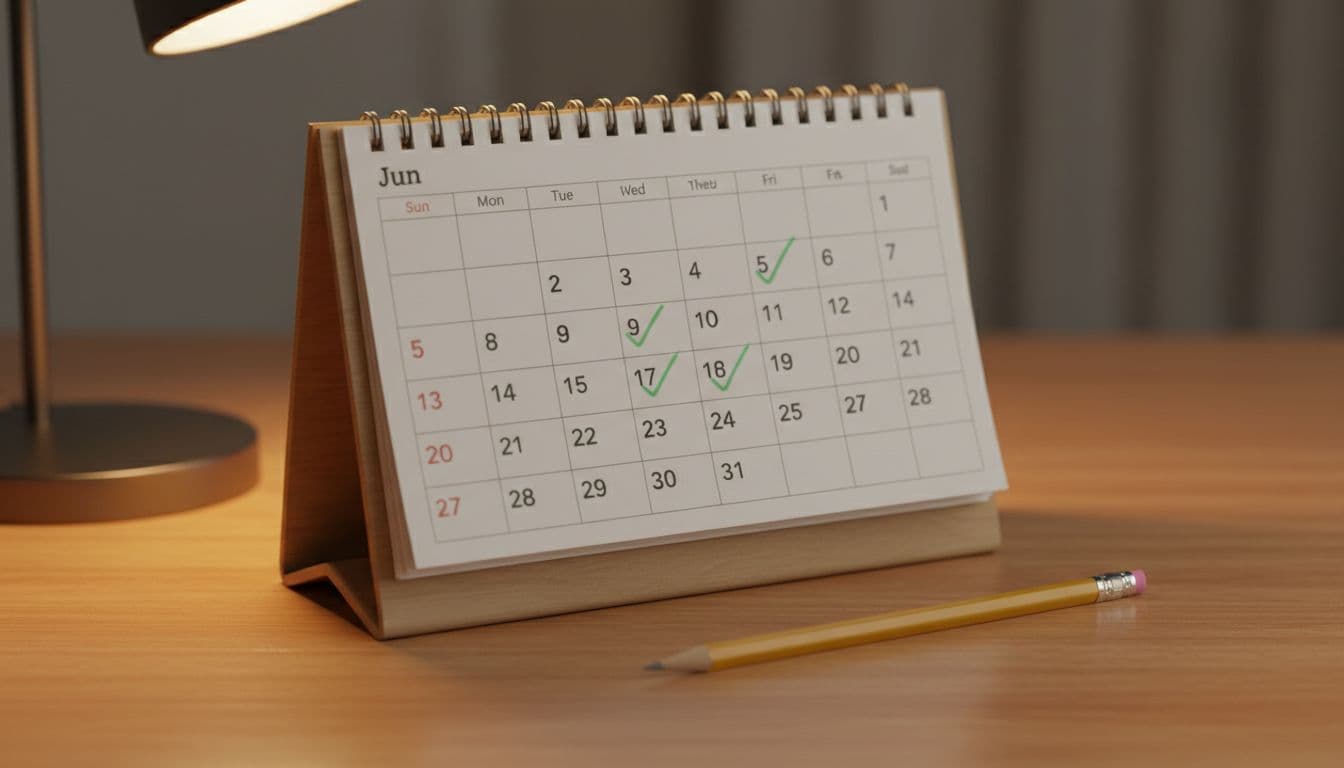
Score the round in seconds (so you get the dopamine without the drama)
Scoring should take less time than the round itself. If tracking feels like homework, you’ll stop.
Try one of these lightweight options:
- A checkmark on a paper calendar
- A one-line tally in your Notes app
- An index card with boxes you fill in
Whatever you choose, track the action, not the result. “Did 10 minutes of study” is a clean score. “Felt smart today” is not.
Then add a weekly 5-minute review. Look at your scores and answer two questions: What made rounds easy this week? What made them hard? Adjust the bell or shrink the round if needed.
You don’t need better willpower. You need a clearer score and a faster reset.
Have a “bad day” plan: shrink the round, do not skip it
Bad days are guaranteed. The mistake is acting surprised by them.
Make a rule now: on hard days, do the minimum round instead of skipping. The minimum round is the smallest version that keeps your identity intact. It’s your “I’m still the kind of person who does this” move.
Two examples:
If your goal is fitness, your minimum round could be a 2-minute walk outside or 10 slow bodyweight squats.
If your goal is writing, your minimum round could be opening the document and writing one sentence, or outlining three bullet points for tomorrow.
This works because it keeps the chain alive. It also removes the fear of falling behind. You’re not trying to win the day. You’re trying to stay in the loop.
When the day passes, reset. The next bell is coming, and you’ll be ready for one more round.
Conclusion
“One More Round” works because it turns your goal into a repeatable loop: pick a bell, do a next small win step, score it, then reset. That’s the Bell Mindset in practice, and it’s built for real life, not perfect weeks.
Pick one goal right now. Write your next round so it takes 2 to 15 minutes. Then choose the bell that will trigger it (after coffee, after logging on, after school pickup). Do that one round in the next 24 hours, score it, and reset. Tomorrow, listen for the same bell and go again. One more round is how big change starts looking small enough to finish.