Quit-Proof Your Environment: Set Up Your Room, Phone, and Calendar So Giving Up Takes More Effort
You had a plan. Maybe it was a workout, a study session, a writing sprint, or a simple budget check. Then your room felt messy, your phone lit up, and your schedule got fuzzy. Ten minutes later, you’re doing something else and telling yourself you’ll restart tomorrow.
That cycle isn’t a character flaw. Most people don’t quit because they “lack motivation.” They quit because their environment makes quitting easy and starting annoying.
Quit-proofing means designing small barriers against giving up, while making the next right step the easiest step. It’s less about hype and more about defaults that still work on low-energy days.
This article gives you a simple setup for three places where quitting usually starts: your room, your phone, and your calendar. When those three cooperate, follow-through stops being a daily fight.
Start with a quit-proof plan: remove the easy exits and shrink the first step
Quitting usually happens at the exact moment the next step feels too big, too unclear, or too annoying. Not forever, just “not right now.” That tiny delay is often the real end.
So you need two simple levers:
First, add friction to quitting. Make the escape route take a little longer. Not impossible, just inconvenient enough that your brain pauses.
Second, remove friction from starting. Make the first action so small and obvious that you can do it even when you’re tired.
Think about four common examples:
With workouts, the quitting moment is often changing into gym clothes. If the clothes are buried and the shoes are somewhere random, you’ll “start later.” If they’re already staged, the first step is basically done.
With studying, the quitting moment is opening the right tab, finding the assignment, and remembering where you left off. If you have to re-orient every time, you’ll drift.
With writing, the quitting moment is staring at a blank page. If the doc opens to a messy draft and you don’t know what to write next, you’ll check your phone.
With saving money, the quitting moment is making a decision when you’re hungry or rushed. If spending is one tap and saving takes ten steps, guess what wins.
The goal is not perfect discipline. The goal is to design your day so the “default path” points toward progress. You’re building rails, not relying on a pep talk.
If starting takes 10 seconds and quitting takes 2 minutes, you’ve already tilted the odds in your favor.
Do a quick “quit audit” to find your top triggers
Before you reorganize your whole life, run a five-minute quit audit. You’re looking for the predictable moments where you slide off track.
- When do you usually stop? Be specific. “After work at 6,” “after lunch,” or “around 9:30 pm.”
- What do you do instead? Scroll, snack, clean, text, lie down, open games, watch one video.
- What’s the first bad trade? It’s rarely a full collapse. It’s one snooze, one clip, one handful, one “quick check.”
- What feels annoying about starting? Missing tools, messy space, unclear next step, low energy, too many choices.
- What would make starting easier tomorrow? One small change, not a new personality.
Most people find the same three triggers: visual clutter, phone interruptions, and a vague schedule that leaves too much room for “later.”
Now pick one habit to protect for the next 14 days. Not five habits. One. Quit-proofing works best when you can actually notice the difference.
Use the 2-minute setup rule so starting feels automatic
Your habit doesn’t need to feel easy. The start needs to feel easy.
The 2-minute setup rule means you pre-pack the first two minutes so you can begin without thinking. You’re building an on-ramp. Once you’re moving, it’s much easier to keep moving.
Try this simple template:
“When it’s time, I only have to do X.”
X should be tiny and physical when possible.
For exercise, X might be “put on shoes.” For studying, it’s “open laptop to the assignment tab.” For writing, it’s “open the doc and write one messy sentence.” For saving, it’s “open the bank app and transfer $5.”
Notice what this does. It removes the fog. It removes debate. It turns your habit into a single clear motion.
Also, don’t confuse the on-ramp with the whole drive. Two minutes is not the goal. Two minutes is the doorway.
Set up your room so the right choice is the easiest choice
Your room is either a silent coach or a silent heckler. It nudges you with what it shows you, and it slows you down with what it makes you search for.
Environment design is mostly three things: placement, visibility, and fewer decisions. You don’t need a bigger apartment or fancy organizers. You need your space to answer one question fast: “What do I do next?”
That starts with your “action zones.” Even in a small room, you usually have a few repeat spots: the bed, a desk or table, and the doorway. Each spot should have a job.
If you work in a bedroom, keep your focus area visually clean. If you share space with roommates or family, use a small bin or drawer as a “portable focus kit.” If your room is tiny, use vertical space and a single clear surface you can reset quickly.
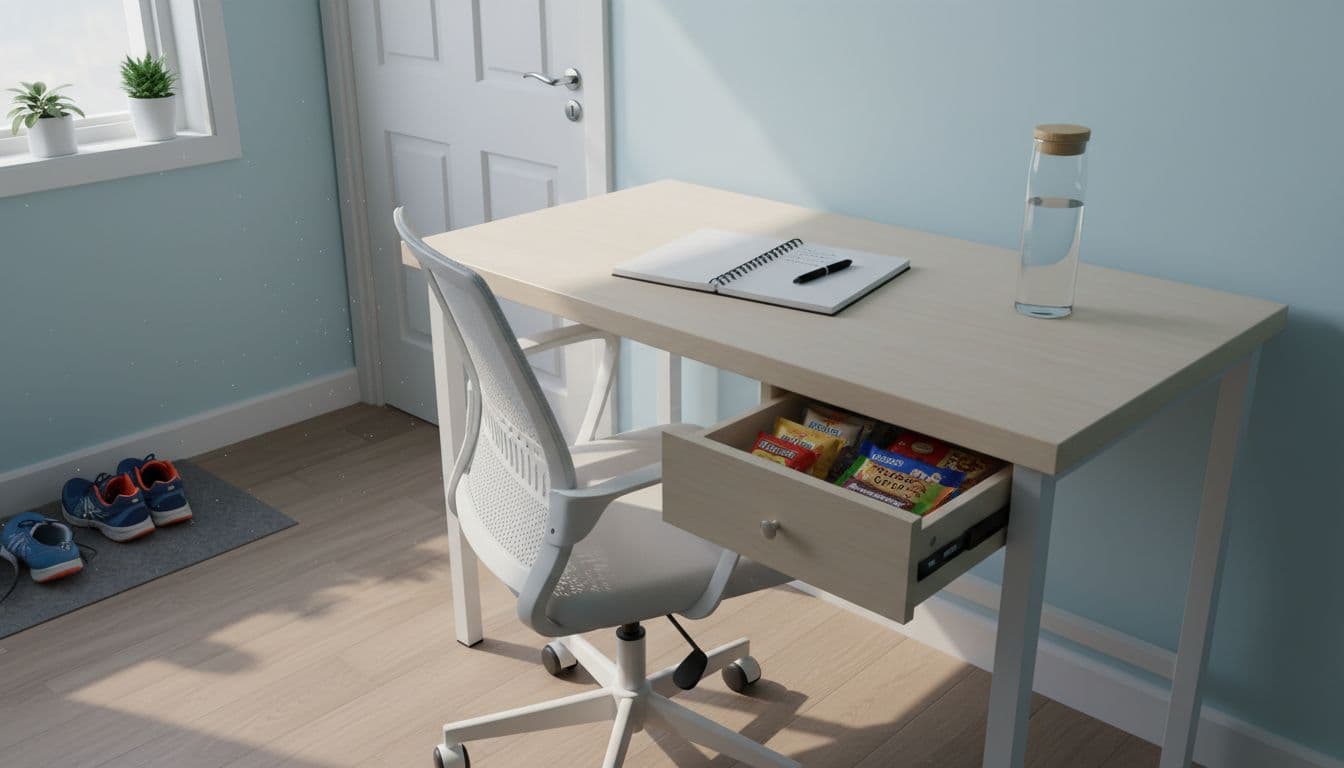
A practical rule helps: reduce the number of “maybe” objects in your main view. Maybe objects create micro-decisions, and micro-decisions drain you.
Change what is in your line of sight: cues in, temptations out
“See it, do it” is real. “See it, want it” is real too. Your eyes pull your body.
So put your habit cues where you’ll trip over them (in a good way). Keep the journal open on the desk. Leave a water bottle where you’ll reach for it. Place your textbook on the chair so you have to move it to sit down. Put your resistance band on the doorknob. Make the healthy thing obvious.
At the same time, move temptations out of your line of sight. You don’t have to throw anything away. Just make it take effort. Put the game controller in a drawer. Box up snack foods and place them high or in a closed cabinet. Store the TV remote in a drawer, not on the couch. If you can, face the bed away from the desk so “lie down” isn’t the first idea your body gets.
One powerful move is building a single focus surface. It can be a desk, a small table, or one cleared corner. Keep it mostly empty. When it stays clean, it becomes a signal: “This is where I start.”
Pre-stage your environment the night before (a 3-item reset)
Most quitting happens in the morning because the morning is full of friction. A small nightly reset removes that friction before it shows up.
Keep it to three items so you’ll actually do it:
- Stage tomorrow’s key items. Clothes, shoes, book, lunch container, or your “focus kit.”
- Clear one small area. Just your desk surface or a single chair, not the whole room.
- Write the first next step. A sticky note works, like “Open doc, fix intro” or “25 minutes, chapter 3.”
That’s it. The point is to reduce the number of decisions you face when you’re half awake. It also cuts off the “I’ll do it later” loop because later never has a clear starting point.
Turn your phone from a derailment device into a support tool
Your phone isn’t evil. It’s just efficient. It gives you dopamine, novelty, and social feedback in seconds. Meanwhile, your real goals usually pay off slowly.
So the goal isn’t to never use fun apps. It’s to use them on purpose, not as a reflex.
A quit-proof phone setup does two things at once. It stops attention leaks, and it adds speed bumps to the apps that pull you off track.
Start small. You’re not trying to become a monk. You’re trying to stop your phone from hijacking the first 30 seconds of every quiet moment.
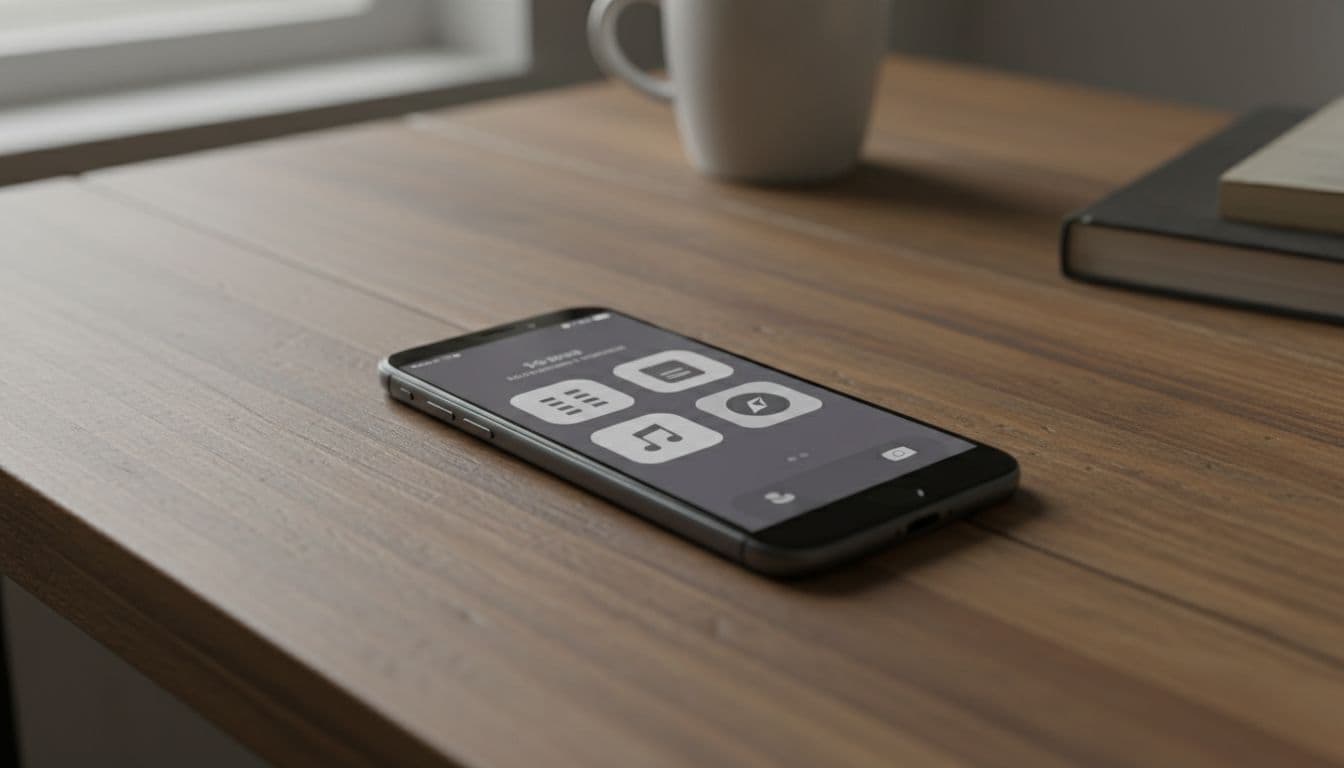
Stop the attention leaks: notifications, badges, and home screen design
Notifications are tiny interruptions that pretend to be urgent. Most of them are not.
Start with the highest impact changes. Turn off notifications that aren’t from real people. News alerts, game pings, “we miss you” messages, and random promos don’t get to interrupt your day. Next, remove red badges from social apps. Those badges are designed to create itch.
Then set one Focus mode (or Do Not Disturb schedule) for work or school. Allow calls or texts from the few people who matter, and silence the rest. Keep it simple so you’ll keep it on.
After that, clean up your home screen. Remove distracting apps from the first page. You can still keep them, just bury them in a folder or move them to the App Library. Aim for 4 to 8 good default apps visible, like calendar, notes, music, maps, and maybe your camera.
A quick rule keeps this honest: If it’s not urgent or personal, it doesn’t get to interrupt you.
Add speed bumps to distractions (without needing willpower)
Once notifications are under control, add “friction layers.” Each layer makes impulsive use less automatic.
Two layers usually change everything:
Logging out of problem apps helps because re-entering a password breaks the trance. Another option is deleting the app and reinstalling it only on weekends. That sounds extreme, yet it’s surprisingly effective for the worst offenders.
Grayscale during focus blocks reduces the “candy color” pull. App timers can work too, as long as you treat them as guardrails, not a test of willpower. If you scroll past your limit every day, raise the friction instead of getting mad at yourself.
Also, move your charger. If your phone charges next to your bed, your brain learns a simple pattern: bed equals phone. Put the charger outside the bedroom or across the room. If mornings are a mess, use a real alarm clock for two weeks and see what happens.
Pick just two speed bumps to start. More than that can feel like punishment, and punishment rarely lasts.
Use your calendar to protect progress, even on busy weeks
A quit-proof environment still needs one more thing: a clear plan for when you’ll act. Otherwise your habit floats around as a nice idea.
Your calendar is an anti-quit system because it turns “sometime” into a real decision. It also protects you when life gets loud. When your week gets busy, you don’t rise to motivation. You fall to whatever you scheduled.
This doesn’t require fancy time blocking. You only need a few repeatable blocks and honest backup options.
For students, this might look like a short daily study block tied to a class time, plus a weekend catch-up slot. For working adults, it might be a morning workout block and a lunch break admin block. Either way, the calendar keeps you from renegotiating with yourself every day.
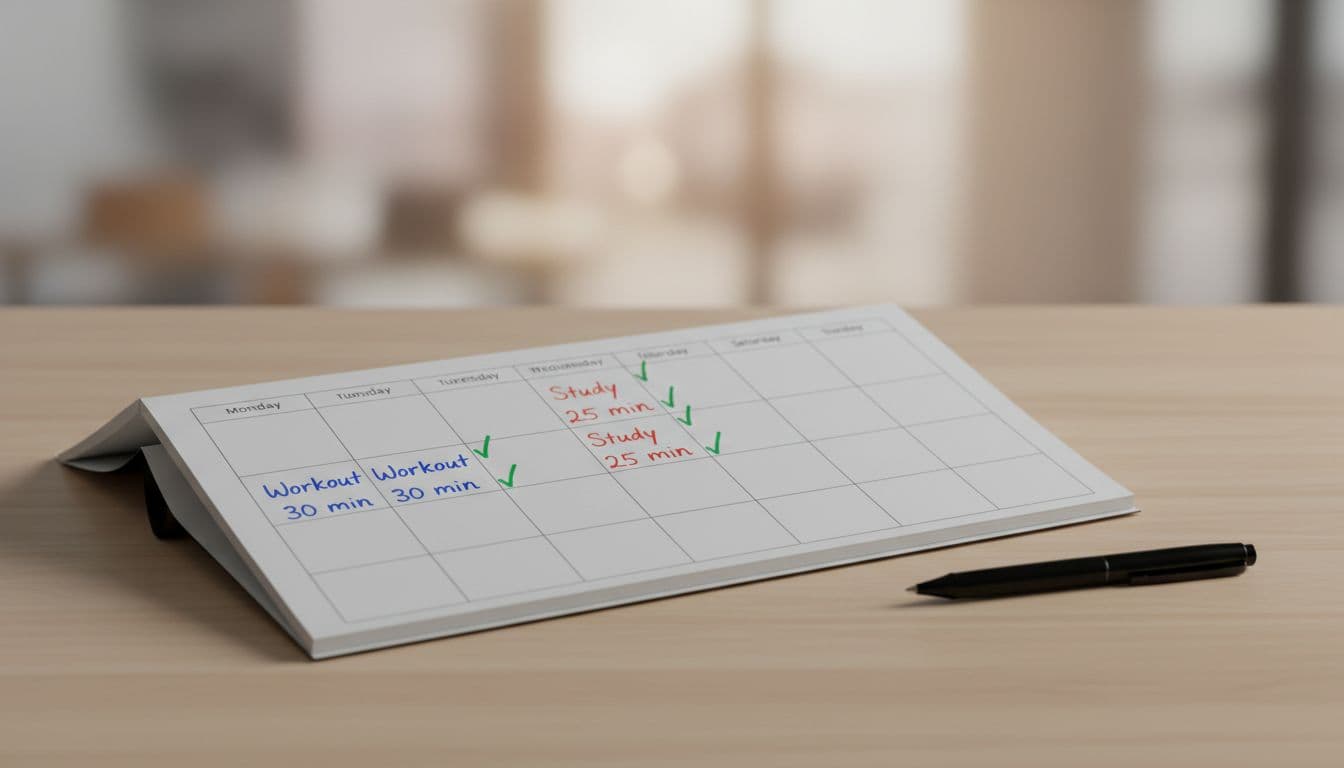
Schedule the habit like an appointment, then lock in a backup plan
Treat your habit like a doctor appointment. You wouldn’t just “fit it in.” You’d put it on the calendar.
Choose one primary time that’s realistic. Then choose one backup time that you can use if life happens. This keeps you from turning one miss into a full stop.
A simple naming convention makes the event feel doable. Write it like this: “Workout, 30 min, easy start” or “Study, 25 min, chapter 3.” That last part matters because it answers the question, “What do I do when I show up?”
Set your reminder 10 minutes before, not at the start time. Those ten minutes are ramp-up time. You can finish a task, put on shoes, refill water, or open the right document. When the reminder fires at the exact start, you’re usually mid-something and you’ll snooze it.
Build a “never miss twice” system with weekly reviews
Missing once is normal. Missing twice is where habits start to die.
A “never miss twice” system is simple: if you miss your habit today, you schedule the next attempt within 24 to 48 hours. You don’t wait for Monday. You don’t wait for the perfect mood.
To make this work long term, do a 10-minute weekly review. Look at the last seven days and ask: what worked, what got in the way, and what needs to change next week? Keep it practical. If evenings keep failing, move the habit earlier. If your desk keeps collecting junk, change the room setup, not your self-talk.
Tracking should feel almost silly. A few checkmarks on your calendar is enough. The point is awareness, not a spreadsheet.
Conclusion
Quit-proofing works because it turns your room, phone, and calendar into one system. Your room makes the right tools easy to reach. Your phone stops stealing the first ten minutes. Your calendar tells you exactly when to show up and what to do first.
Quitting often isn’t a dramatic decision. It’s a series of tiny exits your environment makes too convenient. When you add a little friction to those exits and remove friction from starting, progress becomes the default.
Pick one change in each area and do it in 30 minutes today. Stage your first two minutes, silence the attention leaks, and schedule a primary time plus a backup. Next time motivation is low, your setup will carry you anyway.